Medical Assistant
Medical Assistant
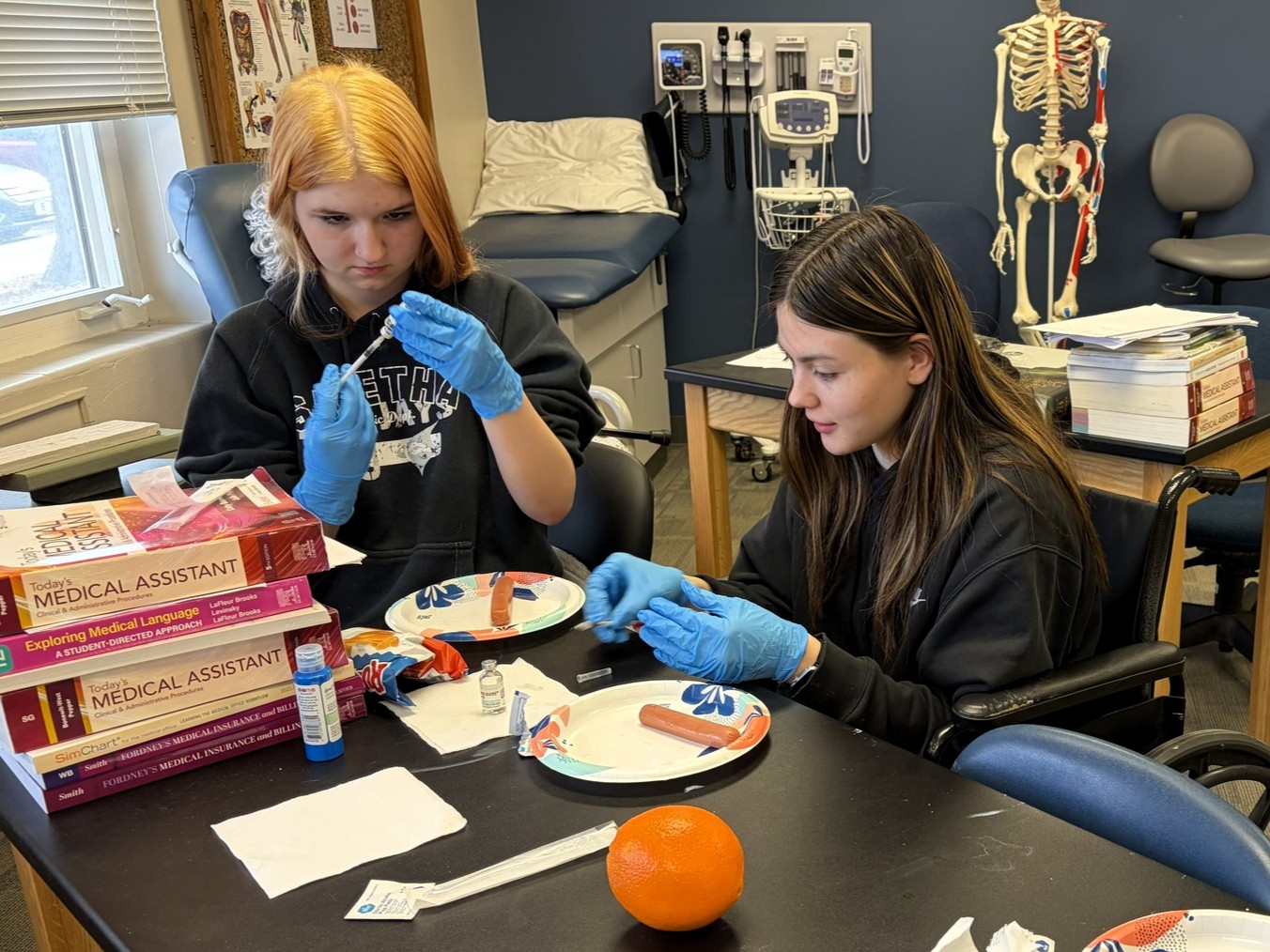
In this program, students learn both administrative and clinical skills:
- obtaining patient histories and vital signs,
- performing phlebotomy and EKG's,
- administering injections,
- applying bandages,
- records management, and
- insurance form processing and billing.
Students complete an externship prior to graduation demonstrating knowledge and skills learned in the classroom. Successful completion of this program enables the graduate to take the Registered Medical Assistant (RMA) exam.
The Medical Assistant program aligns with the National Center for Educational Statistics (NCES). CIP Code 51.0801: Medical/Clinical Assistant. A program that prepares individuals, under the supervision of physicians, to provide medical office administrative services and perform clinical duties including patient intake and care, routine diagnostic and recording procedures, pre-examination and examination assistance, and the administration of medications and first aid. Includes instruction in basic anatomy and physiology; medical terminology; medical law and ethics; patient psychology and communications; medical office procedures; and clinical diagnostic, examination, testing, and treatment procedures.
Certifications: Students who successfully complete the Medical Assistant program are eligible to register for the Registered Medical Assistant (RMA) certification exam.
Helpful Resources
- Certificate B Degree Map
- 2022 Wage Survey
- Approved for Kansas Promise Scholarship
- AO-K Approved Program
Available at These Locations
Medical Assistant Courses (37 Credits Total):
*This course is recognized by the Kansas Board of Regents as Common or Support course within the program.
1 Credit Hours
This course is designed to provide health care professionals with an orientation for their possible future roles in disaster response. Focus will be on the importance of staying within the scope of practice of the profession. The course will also cover being prepared to meet the expectations of their employers, volunteering effectively, and being confident and safe responders.
4 Credit Hours
This course contains the administrative skills of the health care team member. These skills include The Medical Record, Patient Reception, Medical Office Computerization, Telephone Techniques, Scheduling Appointments, Medical Records Management, and Written Communications. It also includes an overview of Electronic Medical Records (EMR) and hands on skills associated with functioning within an EMR.
4 Credit Hours
This course is the beginning of the student’s journey to a successful externship by discussing the ability to apply the skill learned in the classroom and in the lab in the externship. This course also introduces the student to the basics of patient care which includes Medical Asepsis and Infection Control, preparing a patient for examination, acquiring vital signs (adult, child, infant), and assisting the physician with patient exams.
3 Credit Hours
This course is designed to educate the health care team member with the mechanics of submission of electronic/paper insurance claim forms and current industry coding for medical office treatments and procedures.
3 Credit Hours
The content of this course focuses on the introduction to medical terminology. Vocabulary is explored to structure of word, prefixes, suffixes and root words. Emphasis is based on proper usage, pronunciation, spelling and definition of each of the structures commonly used in the medical field.
3 Credit Hours
This course is designed to teach the basics of human structure and function. Emphasis is placed on how tissues, organs, and body systems work individual and together to carry out complex activities such as eating, learning, and responding to stress and interaction with other structures of the body.
2 Credit Hours
The course focuses on the basic concept of professional practice of medicine and the role and function of the Medical Assistant. Students discuss the personal and professional characteristics and legal and ethical standards for the medical assistant and the importance of commitment to your job, working with others, career planning and employment and the practicum experience.
2 Credit Hours
This course is designed to provide experience related to the skills and knowledge acquired in the Medical Assisting field by allowing student to apply classroom and lab knowledge in a real medical arenas.
3 Credit Hours
An introduction to the principles of pharmacology, including drug terminology; drug origins, forms, and actions; routes of administration; as well as the use of generic name drugs, trade name drugs, and categories of drugs to treat various body systems.
3 Credit Hours
This course contains the administrative skills of the health care team member. These skills include handling office mail, managing practice finances, billing and collections and office management. The student learns about the financial responsibilities of medical office assistants relating to posting of charges, payments, and balancing of day sheets.
3 Credit Hours
This course allows the student to advance their technical knowledge by introducing the students to cast application/removal, Understanding Medical Emergencies, patient teaching, conducting patient interviews, and assisting with physical exams.
2 Credit Hours
Prerequisite: All other MOA coursework complete
This course is designed to provide experience related to the skills and knowledge acquired in the Medical Assisting field by allowing students to apply classroom and lab knowledge in real medical arenas.
4 Credit Hours
This course is intended to introduce the student to various aspects of the Clinical Lab, including Introduction to Clinical Lab, Phlebotomy, Urinalysis, Hematology, and Medical Microbiology. The student will learn principles of laboratory safety, quality control, specimen handling, lab values, lab requisitions and lab reporting. Emphasis will be placed on working in a Physician Operated Laboratory and procedures and techniques for collecting specimens (phlebotomy, urine collection, pap smears, throat cultures) taught. Emphasis is placed on safe practices and knowing the responsibilities and limits of the Medical Assistant’s role in collecting, processing, and reporting labs. The student will be introduced to specific collection techniques and given time to practice these techniques as part of preparation for their externship (Clinicals I and II).