Electrical Technology
Electrical Technology
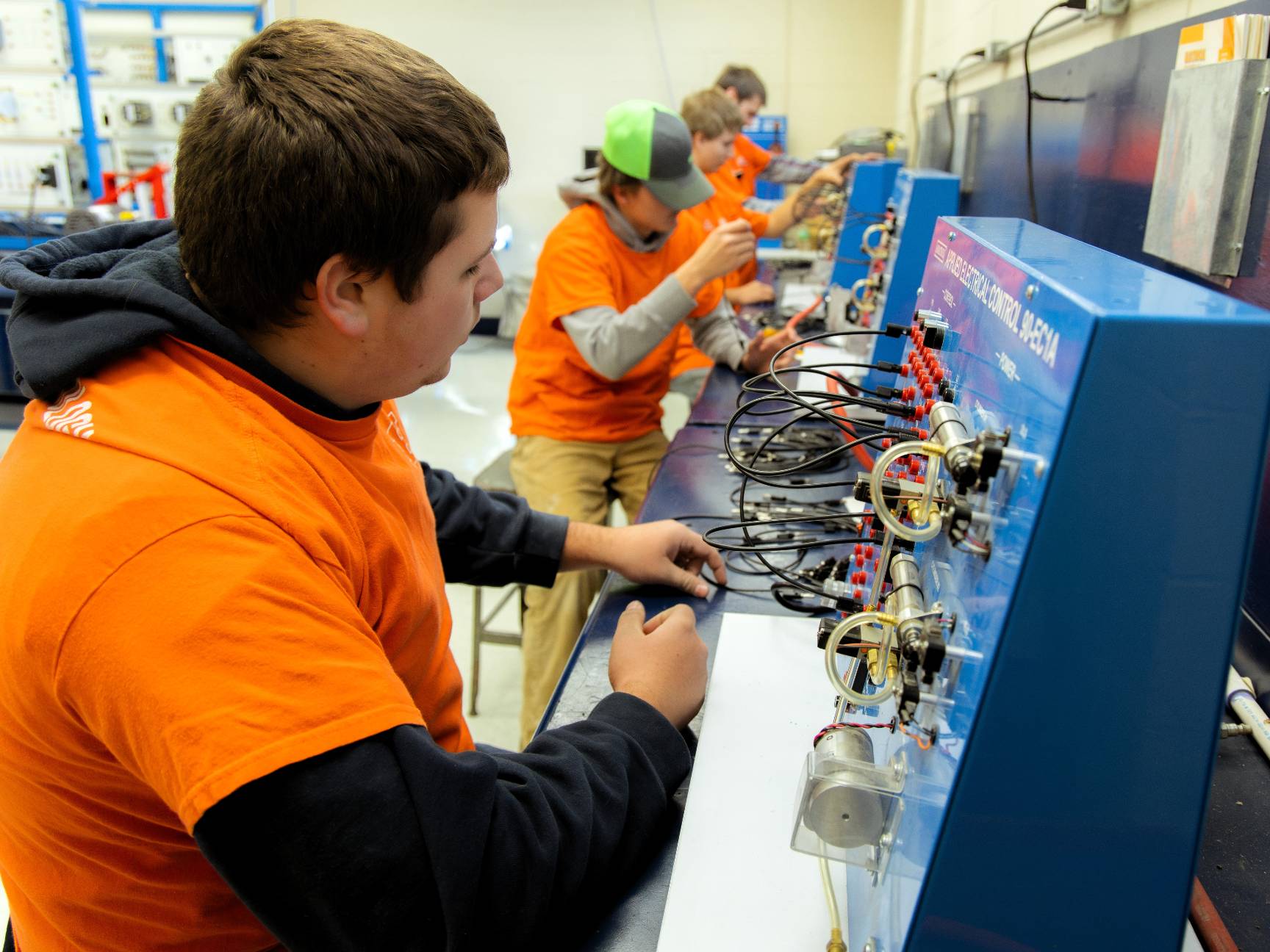
The Electrical Technology program prepares students with a strong foundation in electrical
theory and practical application. Coursework covers AC and DC fundamentals, motor
controls, and residential, commercial, and industrial wiring methods.
Students gain hands-on experience wiring a house using industry-standard blueprints
and diagrams, allowing them to apply classroom knowledge in real-world scenarios.
Students attending full-time can complete the program in approximately eighteen months.
Upon successful completion, graduates earn a Certificate and are eligible to sit for
the Journeyman Block licensure exam.
The Electrical Technology program aligns with the National Center for Educational Statistics (NCES). CIP Code 46.0302: Electrician. A program that prepares individuals to apply technical knowledge and skills to install, operate, maintain, and repair electric apparatus and systems such as residential, commercial, and industrial electric-power wiring; and DC and AC motors, controls, and electrical distribution panels. Includes instruction in the principles of electronics and electrical systems, wiring, power transmission, safety, industrial and household appliances, job estimation, electrical testing and inspection, and applicable codes and standards.
Certifications: Students who successfully complete the Electrical Technology program earn their OSHA 10 certification and, upon gaining the required work experience, become eligible to register for the Journeyman Electrical Exam.
Helpful Resources
- Associate of Applied Science Degree Map| Degree Worksheet
- Certificate C Degree Map
- 2022 Wage Survey
- Electrical Technology Tool List
- Approved for Kansas Promise Scholarship
- AO-K Approved Program
Available at These Locations
Electrical Technology Courses (53 Credits Total):
*This course is recognized by the Kansas Board of Regents as Common or Support course within the program.
1 Credit Hour
This course will: explain job/site safety and precautions for job/site hazards; determine the uses of personal protective equipment (PPE); identify the safety equipment and procedures related to safe work practices and environment; identify fire prevention and protection techniques; explore Hazardous Communications (HazCom) including Material Safety Data Sheets (MSDA).
4 Credit Hours
The focus of this course is to give the student a ground level understanding of direct current (DC) and alternating current (AC) theory. The student will be introduced to electron theory and Ohms’ law and see how these apply to direct current circuits. As the students progress, they will be introduced to series circuits and their equations, parallel circuits and their equations, and combination circuits and their equations.
3 Credit Hours
Students will gain a working knowledge of the theory and practical application of single-phase and 3-phase electrical components. Upon successful completion of this course, the student should be able to interpret and apply the rules of the current National Electrical Code to wiring systems composed of these electrical components.
- Syllabus - Contact admissions for details
- Locations and Class Schedule
4 Credit Hours
An introductory course on residential wiring methods that includes practical applications and hands-on experience in implementing National Electrical Code (NEC) requirements.
2 Credit Hours
Students learn to read specification manuals and prints as applied to the residential, commercial, and industrial buildings.
4 Credit Hours
An introductory course on commercial wiring methods that includes practical applications and hands-on experience in implementing code requirements. This course of instruction will introduce the student to an environment much different than that of residential construction. In commercial applications students have to look at types of structures, location, types of equipment, and requirements of the National Electrical Code (NEC). The course introduces students to the high intensity lighting systems used in commercial and industrial locations. Students learn how to install, maintain, and troubleshoot each system. Students will also receive instruction on application of different lighting systems to suit the application encountered. The course also provides instruction about wiring methods such as conduit, cable trays, surface metal raceways, rigid non-metallic conduits, and a host of other wiring methods used to meet certain locations in commercial applications.
4 Credit Hours
This course will provide troubleshooting and repair techniques. The student will learn how to identify faulty components, develop a repair plan, safely preform repairs, and prevent reoccurrence.
- Syllabus - Contact admissions
- Locations and Class Schedule
4 Credit Hours
An introductory course on the use and interpretation of the current National Electric Code (NEC). This course of instruction is taught throughout the whole program but generally will be intensified during the latter part of the school term. The main focus is to introduce the student to the Block and Associates exam. The course focuses on what makes up the tests, best use of time, highlighting important text in the codebook, and many other helpful testing ideas. The student will spend time taking sample exams and identifying weaknesses and improvements needed.
4 Credit Hours
This course will take a look at what is required in the industrial wiring environment and the designs used in these locations. The study of transformers—single and three phases are begun, along with connection of these systems and voltages found. Some introduction into plant automation and their requirements are also discussed.
5 Credit Hours
In this course students will begin a study of electric motor operation and systems used to control their operation. Fundamentals of single and three phase motors along with their operational characteristics are covered. Students learn the language of control, ladder diagram, and the logical sequence in which things must happen in order for a machine or process to operate. Lab experience helps develop skills to operate, install, design, and troubleshoot AC electric motor control circuits for various applications. The current National Electrical Code (NEC) will be used in this course.
3 Credit Hours
This course prepares the student to interpret standard electrical schematics and construction blueprints. Students learn to read specification manuals and schematics as applied in the industrial field.
- Syllabus - Contact admissions
- Locations and Class Schedule
5 Credit Hours
This course is a continuation of ELE162 Electrical Motor Operations & Control. Its purpose is to provide an understanding of reversing motor circuits, solid state devices and system integration, timing and counting functions, relays and solid state starters, sensing devices and controls. Students connect numerous types of control sequences in the shop, along with diagramming and troubleshooting equipment. The current National Electrical Code (NEC) will be used in this course.
- Syllabus - Contact admissions
- Locations and Class Schedule
2 Credit Hours
This course provides an introduction to programmable logic controllers (PLCs) and their industrial and commercial applications. The course will cover the fundamentals of operation, installation, and programming. This course is for students who have completed all the motor control requirements.
4 Credit Hours
This course will provide practical and a real-world systematic approach to troubleshooting. Students will study electrical troubleshooting including evaluating customer complaints, observing system operations, formulating a plan, reading, and interpreting schematics.
- Syllabus - Contact admissions
- Locations and Class Schedule
4 Credit Hours
Prerequisite: ELE 142
A continuation of the National Electrical Code I course on the use and interpretation of the current National Electrical Code (NEC). Its purpose is to prepare students for the Block and Associates exam. The course focuses on what makes up the tests, best use of time, highlighting important text in the codebook, and many other helpful testing ideas. Students will spend time taking sample exams and identifying weaknesses and improvements needed.